Arbeitsbereich
Migration und Mobilität
Auf einen Blick
Projekte
Publikationen
Team
Projekt
Understanding Patterns of Immigrants’ Integration in Online Spaces
Jisu Kim, Emilio Zagheni, André Grow-Böser; in Zusammenarbeit mit Soazic Elise Wang Sonne (The World Bank Group, Washington, D.C., Vereinigte Staaten), Kiran Garimella (Rutgers, The State University of New Jersey, New Brunswick, Vereinigte Staaten), Ingmar Weber (Saarland University, Saarbrücken, Deutschland)
Ausführliche Beschreibung
Research on immigrant integration has typically focused on studying interactions and relationships between immigrants and natives in physical spaces, such as neighborhoods, schools, and workplaces, as well as along dimensions of socioeconomic status. However, with the advent of the Internet and the proliferation of social media platforms, a significant portion of human interaction is now taking place online. It is thus important also to assess integration patterns in online spaces because activities and social connections formed online can have important consequences for integration along classic dimensions, may reduce or expand inequalities, or reflect existing patterns of disparities.
In this project, we aim to understand the patterns of immigrants’ integration in online spaces along with key dimensions that are considered in traditional integration research. For example, we curated a high-quality data set to quantify patterns of new online social connections among immigrants in the United States. Specifically, we focused on Twitter and leveraged the unique features of these data in combination with a propensity score matching technique to isolate the effects of migration events on social network formation. Our results have shown, among others, that immigration events led to an expansion of the immigrants' networks in terms of people whom they follow on Twitter in the destination country, relative to those of users who had similar characteristics but did not move. However, we did not find evidence that migration events expanded the immigrants' networks of followers in the destination country.
In a related project, we used data from Twitter to investigate the traits of different communities on the platform, comprising both immigrants and natives. We analyzed profiles and tweets, and we conducted an extensive network analysis to examine the behaviors and characteristics of these groups in a specific online space. Our findings have revealed that immigrants and natives showed unique tweet activities and popularity patterns, with users tending to connect with others based mainly on their country of origin. This behavior was also reflected in the communities we identified, which were characterized by homophilic tendencies.
Future developments include investigating how patterns of social integration differ between online and offline spaces among immigrants in the United States. To this end, we plan to utilize an existing survey that employed snowball sampling to collect data on immigrants’ social connections and location choices in offline spaces, thus creating a network of participants. By comparing this information with the social network data obtained from Twitter, we aim to identify similarities and differences between the two domains. For example, we may find that immigrants who are socially connected offline are also more likely to be connected online.
To conduct this analysis, we will employ multilevel network analysis. This approach allows us to analyze the interactions between individuals and their social contexts, such as their location, socioeconomic status, and cultural background. Overall, this study is important because it sheds light on the complex dynamics of social integration among immigrants and identifies factors that contribute to their social connections in both online and offline spaces.
Ridgeline-Diagramm des Anteils der in den USA ansässigen Freund*innen nach der Migration für Migrant*innen
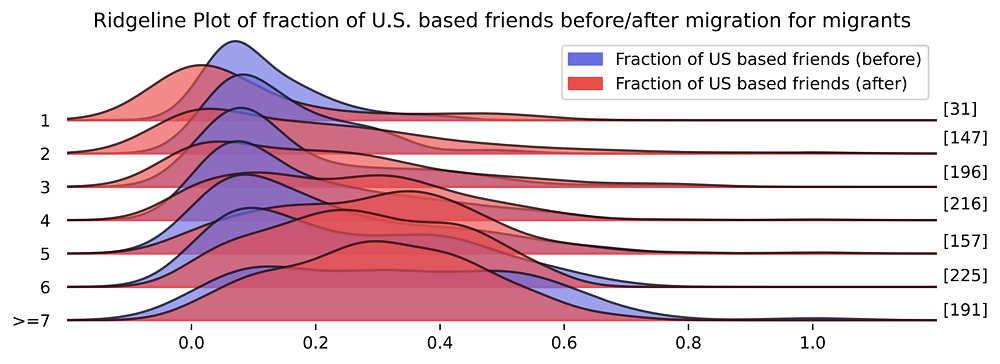
The y-axis represents number of years spent in the U.S. Here, we observe that as the number of years migrants spent in the U.S. increased, the fraction of friends they had after migration shifted towards the right. This indicates that migrants who had been in the U.S. for longer periods of time had more U.S.- based friends on Twitter. More specifically, we observe a clear shift for migrants starting in the third year since migration. On the other hand, we also observe that the distributions of the fraction of friends before and after migration were identical in the first year since migration and in the seventh year since migration or later. © Kim, J.; Wang Sonne, S. E.; Garimella, K.; Grow, A.; Weber, I. G.; Zagheni, E. (2023). Online social integration of migrants: evidence from Twitter. Migration Studies, 1–28
Deutschland, Vereinigte Staaten, Welt
Publikationen
Khatua, A.; Zagheni, E.; Weber, I. G.:
In: Proceedings of the Seventeenth International AAAI Conference on Web and Social Media (ICWSM): Limassol, Cyprus, June 5th - 8th, 2023, 1143–1147. Palo Alto, CA: AAAI Press. (2023)

Kim, J.; Wang Sonne, S. E.; Garimella, K.; Grow, A.; Weber, I. G.; Zagheni, E.:
MPIDR Working Paper WP-2023-012. (2023)
Kim, J.; Wang Sonne, S. E.; Garimella, K.; Grow, A.; Weber, I. G.; Zagheni, E.:
Migration Studies, 1–28. (2023)
Chin, A.; Coimbra Vieira, C.; Kim, J.:
In: WebSci '22: proceedings of the 14th ACM Web Science Conference, Barcelona, Spain, 26-29 June 2022, 296–301. New York: Association for Computing Machinery (ACM). (2022)
Kim, J.; Pratesi, F.; Rossetti, G.; Sîrbu, A.; Giannotti, F.:
Social Network Analysis and Mining, 1–23. (2022)
Kim, J.; Sîrbu, A.; Rossetti, G.; Giannotti, F.:
In: Complex networks and their applications X: Volume 1, Proceedings of the Tenth International Conference on Complex Networks and Their Applications COMPLEX NETWORKS 2021, 130–141. Cham: Springer. (2022)